
“Not all men.”
It is a phrase that has become almost instinctive whenever women speak about sexual violence. And, of course, it is true. Not every man is a perpetrator of sexual violence. But the question is not whether every man would commit sexual violence, but what happens when men witness it and whether they choose to intervene or stand by and allow it to happen.
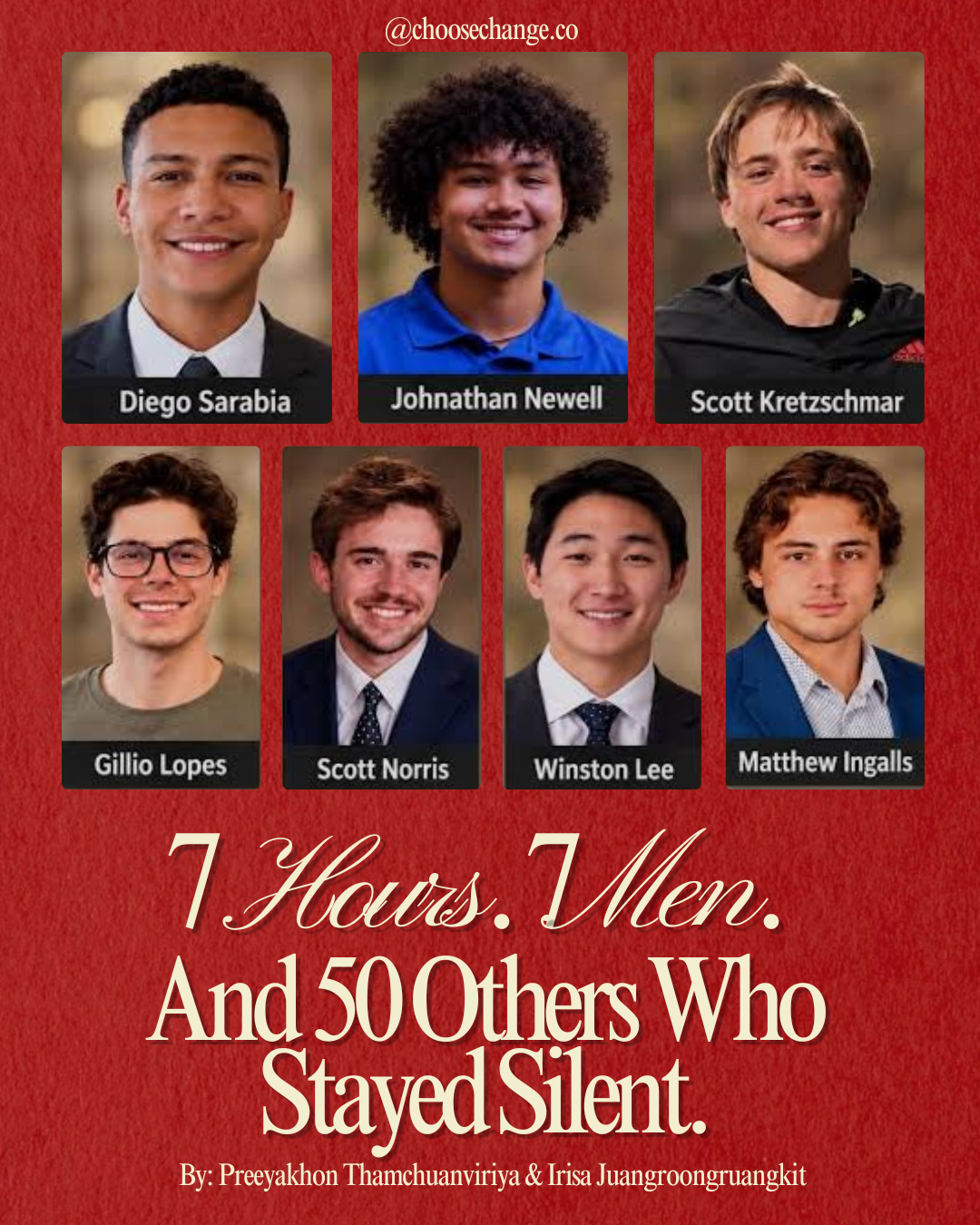
The recent case involving seven Cornell University students has brought this question into the spotlight. In October 2024, a 20-year-old Cornell student, identified in legal documents as Jane Doe, went to the university’s Chi Phi fraternity house. She subsequently reported a sexual assault to Cornell University Police. In a civil lawsuit filed in September 2026, she alleges that she was pressured into consuming ketamine and alcohol before being sexually assaulted by multiple fraternity members over several hours while she was incapacitated and unable to consent. Seven current and former students were named as defendants.
In September 2026, almost two years later, Jane Doe filed a civil lawsuit against Cornell, the Chi Phi fraternity house and other parties, bringing renewed attention to the events of that night. After initially resulting in no criminal charges, authorities have reopened the investigation with New York Governor Katy Hochul appointing Attorney General Letitia James as a special prosecutor.
Beyond the Seven
What has attracted particular public attention is not only the alleged assault itself, but the fraternity group chat surrounding it. Although seven men are now at the centre of the allegations, silence did not belong to those seven men alone.
The lawsuit describes a Snapchat group called “Chi Phi Actives,” where an explicit message, “Free p***y” referring to Jane Doe, was sent, followed by messages including “Like you can walk in and whip it out” and “Shop still open?” that invited 50 other fraternity members upstairs during the incident. The lawsuit alleges that additional members subsequently entered the room.
However, this does not mean every person in the group participated in the alleged assault. Nevertheless, the existence of the group chat raises a question that extends far beyond Cornell: What responsibility belongs to the people who are not committing the violence, but are in a position to recognise and challenge it?
Sexual violence does not occur only because of the individual who commits it. It is also enabled by environments in which harmful behaviour is normalised, joked about or met with silence. The reported groupchat messages are therefore significant because they show the absence of bystander responsibility.
Where was the intervention? Where was the person who decided that protecting a vulnerable woman was more important than protecting a friend? Where was the message saying “This is unacceptable, stop, and get help”? These are questions about the culture that allows sexual violence to exist alongside friendship, social status and collective silence.
As women, we fear “all men” because the concern is rarely limited to encountering a violent man, but also the possibility that the people surrounding him will not intervene. Thus, “not all men” is an incomplete response. Women are not claiming that every man will sexually assault them, but describing an environment in which they cannot always know which men are safe, which men will intervene, and which men will remain silent.
Not all men are perpetrators. But how many will stand up to the men who are?
Yet the Survivor Is the One Who Leaves
Following the report, the Chi Phi fraternity chapter was shut down and remains barred from campus. Cornell’s disciplinary process resulted in different punishments for the students involved, including the expulsion of two students, Matthew Ingalls and Jonathan Newell, and lesser sanctions for the others, including suspensions and educational assignments. The lawsuit also states that fraternity members were given opportunities to mitigate their conduct by submitting essays to Cornell.
After learning this, social media has been outraged over whether the consequences were proportionate to the actions committed. There is an understandable need for universities to maintain fair disciplinary procedures. Accusations alone cannot determine guilt, and students must have the opportunity to respond to allegations against them. But fairness to the accused cannot mean indifference towards the survivor.
If serious sexual misconduct is established, consequences must reflect the seriousness of the offence. An essay cannot undo trauma. A workshop cannot restore a person's sense of safety. A promising future cannot be considered more valuable than another person's safety.
Yet, while some of the men remained at Cornell following the disciplinary proceedings, Jane Doe was left dealing with the consequences of the incident. According to her lawyer, she was "traumatised, numb and unable to function or accept the horror of what had happened" in the days afterwards, ultimately dropping out of Cornell University.
This again raises a question: why should reporting sexual violence result in a survivor losing her community and education? A system designed to protect students cannot consider its responsibility is fulfilled simply because an investigation has taken place. It must also consider whether the survivor reporting harm is able to remain safe, supported and able to continue her life.
A Case That Became Public
The Cornell case has now attracted widespread attention. Social media users have criticised the students named in the lawsuit, fraternity culture and Cornell’s handling of the situation. The Cornell Daily Sun’s editorial board has also publicly criticised the university’s response. Yet, beyond the public discourse surrounding this one case, it does bring us to question how many cases never receive this level of attention?
For every case that reaches national headlines, there are survivors who never report. There are reports that never become public. There are cases that never reach a courtroom, an investigation or a social-media discussion.
Sexual violence does not become serious when it becomes newsworthy. It is serious whether or not anyone is watching.
The visibility of the Cornell case should therefore not lead society to treat it as an isolated incident. Instead, it should encourage a broader reflection of the social and institutional conditions that allow sexual violence to persist, and of the responsibility of those who witness it.
“We are Jane Doe until no one is Jane Doe”
The public response has also taken a striking form of solidarity. As some social media users have attempted to uncover Jane Doe’s identity, women have begun posting “I am Jane Doe” to express support for her anonymity and challenge efforts to identify her. According to reporting by the Associated Press and Reuters, the movement has also started protests for more repercussions for the seven men and allowed survivors to share their own experiences of sexual violence.
The significance of this movement lies in its refusal to let the search for a survivor’s identity become another means of intimidating her into silence. Rather than allowing public attention to expose the woman who reported the assault, supporters have redirected that attention towards the broader issue of sexual violence and the treatment of survivors.
“I am Jane Doe” shows that while not every woman shares the same experience, no survivor should have to sacrifice her privacy to have her experience taken seriously.
Raise Your Boys Differently
For decades, much of the conversation surrounding women's safety has focused on teaching girls how to avoid violence. Ask any girl, and she will tell you she has heard:
- Do not walk home alone
- Watch your drink
- Share your location
- Be careful about what you wear
While these precautions may have practical value, they cannot be the foundation of our approach to preventing sexual violence. The responsibility of preventing sexual violence should not rest on the potential victims.
We need to raise boys differently. That means teaching boys not only that sexual assault is wrong, but also how to respond when they witness behaviour that could lead to it.
Teach them to recognize when someone is vulnerable. Teach them that consent is fundamental, not optional, and that it can be withdrawn at any time. Teach them that degrading women is not harmless humour. Teach them that intervening when a friend behaves inappropriately is an act of responsibility, not betrayal. Teach them that friendship does not require protecting someone from the consequences of harming another person.
And teach them that being a good man is not simply defined by what he personally refuses to do, but by what he refuses to tolerate.
Is It Still “Not All Men”?
Yes, it is not all men. But the men who would never commit sexual violence do not need to spend their energy proving that fact. The men who are truly part of the “not all men” demonstrate it through their actions: by speaking up, refusing to look away, supporting survivors, and demanding better from the institutions and communities surrounding them.
The men who are truly part of the “not all men” understand why women are angry, and why they continue to speak about the problem collectively. Because “all men” does not mean that all men commit sexual violence, but that too many men remain unwilling to confront the conditions in which sexual violence occurs.
Until challenging these conditions becomes the norm, women will continue to carry the burden of protecting themselves from violence that they did not create. Because while not all men are perpetrators, it is always a man.
Sources
- Associated Press. “Woman Told Cornell Investigators She ‘Felt Like Bait’ during Alleged Gang Rape.” AP News, https://apnews.com/article/cornell-rape-allegations-investigation-cfdaa9d855cc0c13929059e30fc69b4a.
- Charalambous, Peter, et al. “District Attorney Reopens Case of Alleged Cornell University ‘Gang Rape.’” ABC News, 27 Sept. 2026, https://abcnews.com/US/district-attorney-reopens-case-alleged-cornell-university-gang/story?id=136806149.
- “Jane Doe’s Account of What Happened at Cornell Frat, from Text Messages and Investigators’ Transcripts.” CBS News, https://www.cbsnews.com/news/jane-doe-cornell-university-rape-allegations-text-messages-transcripts/.
- Qusba, Cereese. “Records Reveal Cornell’s Punishments for Seven Chi Phi Defendants.” The Cornell Daily Sun, 5 Oct. 2026, https://www.cornellsun.com/article/2026/10/records-reveal-cornell-s-punishments-for-seven-chi-phi-defendants.
- Saad, Nardine, and Kayla Epstein. “What We Know about Cornell University Frat House Rape Investigation.” BBC News, https://www.bbc.com/news/articles/cmpq0r1ljpqwo.