
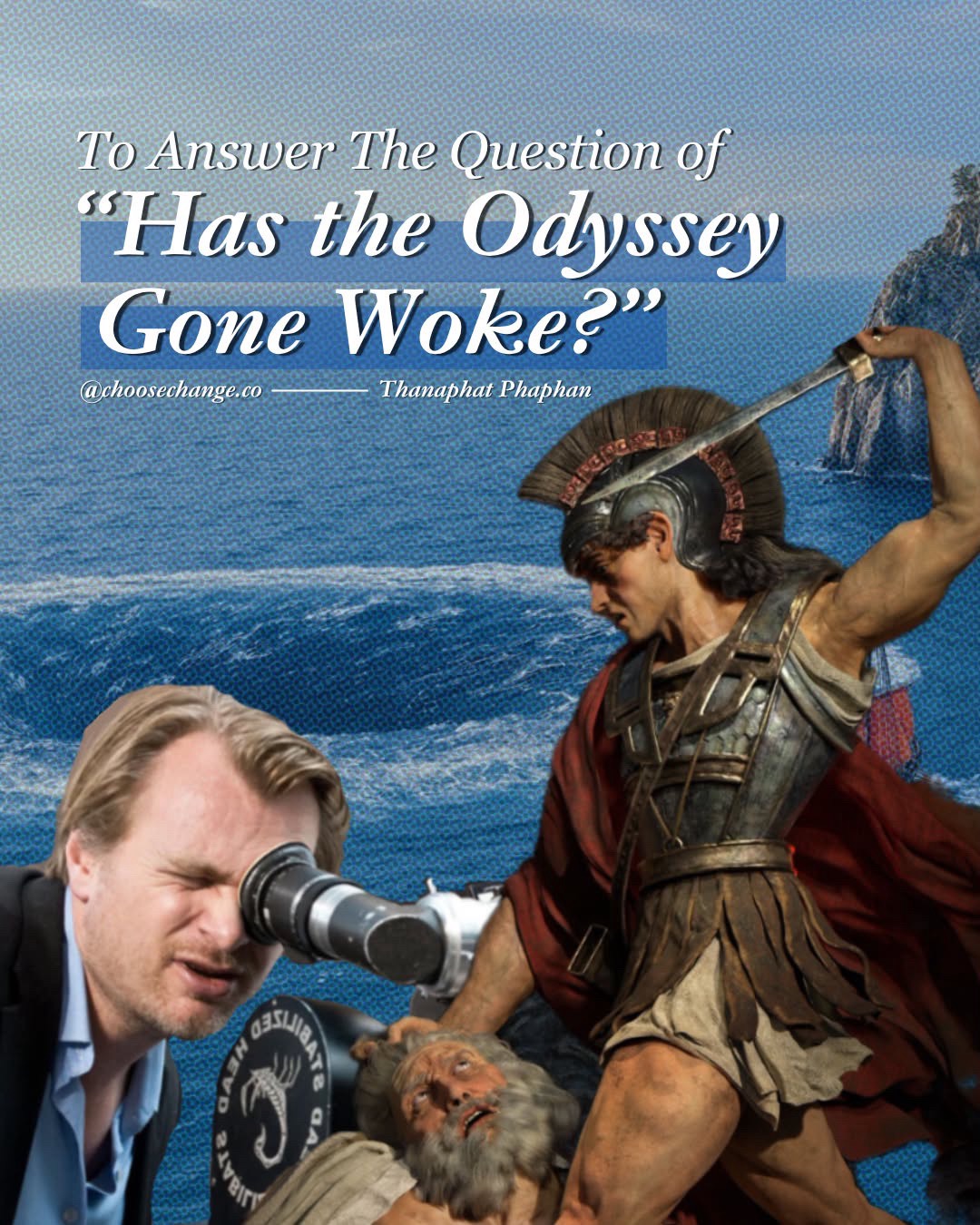
To Answer The Question of "Has The Odyssey Gone Woke?"
Amidst a controversy stemming from the casting choice, Christopher Nolan's The Odyssey nonetheless marked its milestone achievement by reaching the theatrical debut of over $124 million USD domestically, thereby making it the third-highest box office performance of 2026.
Like the legendary director Martin Scorsese, Nolan is considered a Carte-Blanche director, one who is granted complete creative freedom by the studio. This trust has led him to the unintended public attention of casting Lupita Nyong'o, a talented Kenyan-Mexican actress, as Helen of Troy, whom many suggest is the very catalyst of the Trojan War and crucial influence to the Odyssey itself.
Though never explicitly assigned by Homer, the writer, or writers, Helen's skin color has long been depicted as white, as seen in an earlier 2004 blockbuster Troy. At last, some critics raised a question, or much less a statement: "Has Nolan gone woke?"
How woke is defined.
Woke, in this context, is used by opposers as a pejorative term for being too extreme in political awareness. But, according to its supporters, being woke simply means having an educated understanding of social issues. That said, short answer? Maybe not, for some, he hasn't. But if he had, then it would be for the better.
While the implication that Nolan "has gone woke" insinuates that he has not always been this way, the truth is, unapologetically, he has always been woke. In his 2014 film Interstellar, a film which critics regard as one of the best science-fiction movies of all time, he decided to overturn the original draft and change the gender of Murph (the protagonist's child) from male to female, which was ultimately played by Jessica Chastain.
"In the original draft of the script, Murph was originally a boy," Nolan said in an interview with DAZED. "... I found that came very naturally to me, writing the relationship between a father and a daughter." This role greatly influenced the story, and Chastain portrayed it perfectly, partly owing to what is considered a woke move by Nolan.
Both Nolan's Interstellar and the Odyssey are in the epic genre. Interstellar even drew some similar elements from the Odyssey by making the protagonist go on an adventure across the universe. Even more so, if we are to imagine what the Odyssey truly is at its core, or ascribe words to it, epic is probably what comes to mind.
But what makes something epic? And what even is one?
It comes from the word epos, which, in ancient Greek, closely translates to simply a word or spoken narrative. Then we got the adjective epikos to describe a lengthy, grand narrative poem about legendary heroes, gods, and historical events, fictional or not. The Odyssey, in and of itself, is undeniably a work of grandeur. Compiled from a set of 24 scrolls of papyrus, it tells the intricate, 10-year-long journey home of Odysseus, king of Ithaca, the one who devised the Trojan Horse plan leading to what may seem at first as the victory for the Greeks against the Trojans.
In the original text of the Odyssey, Odysseus was a cunning, deceitful, and arrogant man. And as far as any epithet can do him any good, Odysseus can also be considered, indeed, a complicated man.
Tell me about a complicated man.
Or in a more conservative approach
Tell me, Muse, of the man of many ways.
These are the two interpretations of the first line of the epic. The latter version was translated by Richmond Lattimore in 1965, while the former, and what is considered the most contentious rendition (before Nolan's, at least), was by Emily Wilson, a British-American classicist, author, and professor of Classical Studies at the University of Pennsylvania.
Her rendition of the Odyssey in 2017 stripped away a centuries-old bias regarding gender and authority. All prior complete English translations were done by men, and, even inadvertently, they were dappled with heavy male perspectives. She gave Penelope, wife of Odysseus and maintainer of Ithaca, while he tried his way home, much more well-deserved dignity.
Writing in iambic pentameter and mindfully translating the text to around 12,000 lines as the original, she also shed light on a new method to make this classic literature more accessible while keeping the translation as accurate as possible without using pretentious language.
So what is the Odyssey really about?
It is, and as any other stories, a story. It is a story worthy of being told for well over 3,000 years. It is a myth, an epic one. It is up to interpretation for anyone brave and creative enough to challenge the long-accepted idea, and, doing so meticulously, Nolan happened to go with defying Helen's color of skin. Similarly, Wilson's translation redefined what was once a male-dominated perspective of the Odyssey into a fresh point of view on the characters.
Odysseus was flawed, fueled intensively by his hubris, or excessive pride, and no one should hinder or sugarcoat that fact. Helen's beauty is crucial to the story, extremely so, but the face that launched a thousand ships does not have only one fixed color or a mandatory blueprint, nor do they matter at the slightest.
That being said, no, both Nolan and Wilson have not gone "woke" in a deprecatory sense, nor has the Odyssey. Though if your idea of being woke means having fairness and empathy, then they both are, evidently.
References
- Rubin, R. (2026, July 20). The Odyssey box office: Christopher Nolan opening weekend shatters expectations. Variety.
- IMDb. Top 25 Christopher Nolan movies.
- DAZED. (2014, November 5). Jessica Chastain on Interstellar, gender and Hollywood.
- Bumbray, C. (2026, April 21). Christopher Nolan movies ranked: From worst to best. JoBlo.
- Omnia. (2017, November 7). Emily Wilson: The first woman to translate Homer's Odyssey into English. University of Pennsylvania.
External Reading
- Homer. The Odyssey (Emily Wilson, Trans., 2017).
- Homer. The Odyssey (Richmond Lattimore, Trans., 1965).
- Homer. The Iliad.
- Wilson, E. Translator's Note in The Odyssey (2017).
- DAZED. Jessica Chastain on Interstellar, Gender and Hollywood.